StoneGnome

Crochet Love · Crochet & Tunisian Crochet · Studying, Developing, and Teaching Crochet Techniques

  • Home/Blog
  • Crochet
    • Basic Skills
    • Beyond the Basics
    • Advanced Crochet
    • Stitches and Stitch Patterns
  • Tunisian Crochet
    • Basic Tunisian Skills
    • Beyond the Basics
    • Advanced Tunisian Skills
    • Stitches and Stitch Patterns
  • Tutorials n Guides
    • Guides
    • Step by Step Tutorials
    • Stitches and Stitch Patterns
  • Patterns
    • Pattern Posts
    • StoneGnome Shop ♥
    • Visit Ravelry
    • Visit LoveCrafts
  • Themes
    • Slip Stitches (ss)
    • Felting
    • Hats
    • Ribbing
    • Waistcoat stitch Love
    • Top Stitch
    • Amigurumi
    • Small Hearts
    • Ornaments
    • Seasonal Themes n more
  • About
    • Contact Me
    • Copyright and Selling
    • Personal Data & Privacy
The waistcoat stitch is a brilliant two-faced thing. But be aware of the waistcoat stitch trap!

The knit stitch aka waistcoat stitch

To unlock the waistcoat stitch's full potential, it helps to know its secrets and understand the nuances of the waistcoat stitch.

Most crocheters call the waistcoat stitch dense and sturdy while a few of us love it for its drapiness and flexibility.

And why is that? Because there are at least TWO versions of the waistcoat stitch! They differ slightly in appearance and significantly more in structure and flexibility.

You should know about both versions, so you can choose which one to use for a project.

How to Work the Waistcoat Stitch(es)

The Basics

The stitch is created by inserting the hook between the legs of the next stitch.

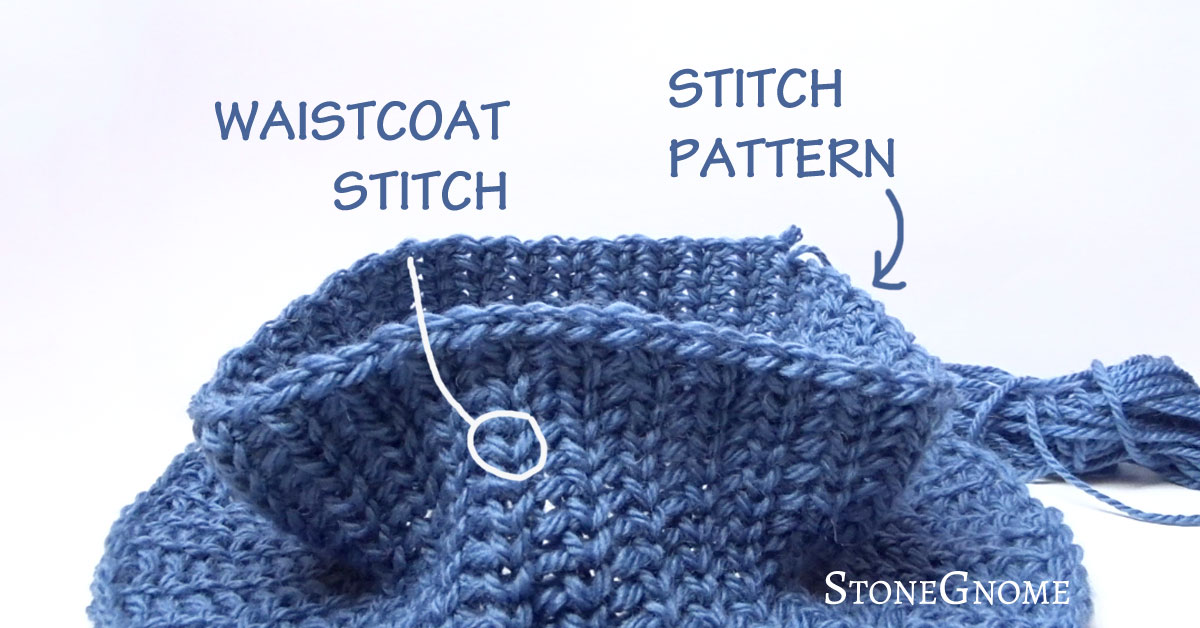
And then there is a trap: There is a vertical bar at the back of the stitch*. It matters whether the hook is inserted before or after this vertical bar. Zoom in at the topmost image to see it.

*Note. Actually, there are two bars at the back. The main culprit is a very straight up-and-down (vertical) bar, while the other is slanted and sits on the side of the stitch. The slanted strand is positioned so far to the side that I doubt anyone considers using it today when working a 'normal' waistcoat stitch. If we count it, we have 3 versions of the stitch. I will disregard this 3rd version for now.

The Most Common Waistcoat Stitch version

Most crocheters naturally insert the hook AFTER the vertical bar at the back. For right-handed crocheters, this is at the left side of the back bar. This is the natural motion when you have the hook in one hand and push it into a stitch.

The waistcoat stitch, natural move of the hook

This gives you one version of the stitch. The denser one.

Currently, the tight version of this stitch is commonly demonstrated in tutorials for the waistcoat stitch. It is likely that most crocheters are not aware of the alternative option or do not consider it to be important.

The 'Secret' Waistcoat Stitch version

Another option is to insert the hook BEFORE the bar at the back. For right-handed crocheters, this means inserting the hook at the right side of the back bar.

This gives you another version of the stitch. A stitch with more drape.

Stitch Hacks

There are different approaches of how to insert the hook when working the last stitch version.

Method #1
Some crocheters elegantly twist their hook, angling it more directly into the stitch or even slightly backward, in the opposite direction. Some of my testers prefer this.
Olga Poltava recently uploaded a YouTube video demonstrating this way of entering a stitch.

Method #2
I prefer to use the lip/nose of my hook to guide the hook into the right place. If necessary, I can use my fingertip at the back of my work to keep the back bar clear of the hook

If you want to try the nose/lip first, then take a look here:


Tips for the Drapey version
  • Find a hook that works for you AND the stitch. Avoid a bulb-headed hook. It's challenging to insert a very blunt crochet hook into the center of a stitch.

    I prefer a tapered hook. However, I did have testers that worked fine with Susan Bate's inline hooks.

  • Crochet lose and control your tension. Once you have pulled up a loop lift your hook a little above the work to crochet looser. 
Read more: How to Change and Control Your Tension

And be patient. If you've never tried this version before, it's like learning a new stitch, so, it may take some time to become accustomed to.

What is the difference?

There are differences between the two versions.

Leaning and Dense

The dense version of the stitch captures more yarn, resulting in a structure where the strands are more entangled and closely packed together within each stitch. This tight interlocking of strands reduces flexibility.

As the denser stitch version grabs the back bar, it is pulled slightly to the side, causing the waistcoat stitches to lean. 

The leaning and dense waistcoat stitch

On the wrong side of the work, the stitches create a neatly structured yet slightly skewed pattern, with the stitches shifting. Being an organized chaos or a coordinated mess.

Straight and with Drape

The less dense version of the waistcoat stitch doesn't grasp the back bar. This allows the strands within each stitch to move more freely, resulting in greater flexibility in the work. Additionally, capturing less yarn means the fabric becomes slightly lighter, creating a thinner texture. With a looser structure, the fabric also gains more drape.

The less-dense waistcoat stitch version hardly leans at all. 

The straight and softer waistcoat stitch

On the wrong side, the stitches also line up beautifully inside each other.


The origin of the Waistcoat Stitch(es)

It is often impossible to determine the exact origin of a stitch, though in this case, we have an approximate idea.

In 2013 Oombawka wrote about the waistcoat stitch and found a book from 1915 (thank you for sharing, Rhondda). The book refers to the waistcoat stitch as 'the new chain stitch', so it is possible the stitch was a recent development when the book was written. 

I recently dug into the same book and was quite surprised to find BOTH versions of the waistcoat stitches in there. 

Understanding the instructions might be a bit difficult. I have highlighted the important parts showing the differences in the working methods of the two stitches. The pictures also provide a clue to distinguish between them.

The waistcoat stitch aka the new chain stitch

It looks to me like the New Chain Stitch is the drapey version of the waistcoat stitch. It looks like the stitches should line up on both sides of the work.

The German waistcoat stitch

The second waistcoat stitch version in the book is a slanted version. At the time it was called the German Waistcoat stitch.

Just to be fair. It is unclear whether the hook is inserted to the left of just one back bar or possibly to the left of both back bars, including the slanted one.
Source: The Sunlight book of knitting and crocheting p. 25-26.

Which Waistcoat Stitch Version to use?

If a pattern does not specify a certain stitch version, it's likely that the designer is only familiar with the 'German' waistcoat stitch version and designed the pattern accordingly.

Then you can choose what to use:
  • Opting for a small hook and the dense 'German' version of the stitch results in a tight, dense, and thick fabric. Cotton yarn emphasizes this. Great for sturdy things like a hat or maybe amigurumi. You also get a nice spiral look, that can be very decorative.
  • Choosing a large hook and using soft, flexible yarn to work the drapey version of the stitch results in a fabric that looks and works more like stitch-stretchy knitted stockinette. Smooth and soft. This fabric is ideal for wearables, blankets, and even softer types of amigurumi, although using a smaller hook may be preferable to keep the filling in place.
I suggest you choose what works better for a specific project and for the result you want to achieve.

Enjoy your next waistcoat stitch project :)

Share
Pin
No comments

Crochet a Halloween Pumpkin. Make it happily orange, stylish, or scary.

Crochet Halloween Pumpkin

Add eyes and a mouth to your pumpkins for a playful touch, or let them keep a chic and neat look.

Updated September 2023.
The pattern has been tweaked and a few helpful images have been added.

The pattern has two pumpkin variations with stem and blossom. It also includes a leaf and wings. A small (optional) twist makes the wings mirrored.

The Halloween Pumpkin pattern includes a lot of helpful images - and is available in English and Danish.

Purchase the pattern now, right here: Buy Now

Or visit Ravelry, LoveCrochet, or the StoneGnome Shop.

Skills Needed

All the minor parts are made with regular crochet stitches. 

The body/head of the pumpkin is made with Tunisian crochet stitches. If you don't know Tunisian crochet, don't worry. You will only need to learn a couple of basic Tunisian crochet stitches to make this, and it can be made with a regular crochet hook (with no handle).

Halloween crochet pumpkins

Reverse Stitches

This is totally optional. But if you want to make the wings truly mirrored, a few unusual stitches are explained in the pattern.

I've borrowed the technique from Tunisian crochet where they are called 'reverse stitches'. However, it is different from the kind of reverse stitches we usually relate to, when we do regular crochet. 

See more in the pattern or check this out: Another kind of Reversed Stitches.

Happy Halloween!

Share
Pin
No comments

Most of us cannot crochet with both hands. Though sometimes it would be useful to be able to.

Another kind of reverse stitches

When I made wings for a pumpkin (yes, for a pumpkin, a Halloween pumpkin), I wanted the reverse side of the second wing to look like the front side. Including the small ridges. 

Updated September 2023

It would have been great if I could have worked the second wing with my left hand. Then it would truly be 'mirrored' versions of the same item.

There is an alternative. In Tunisian crochet, there is something called 'reverse stitches'. Reverse stitches in the world of regular crochet are usually related to stitches like the 'crab stitch', where you crochet in the opposite direction (right-handed work from left to right).

However, with Tunisian crochet, the reverse stitches are not made in a different direction but on the reverse side of the work.

All you do is: 

  • Position the yarn in front of the hook and your work. 
  • Then, insert the hook from BEHIND the work into the regular stitch. 
  • Yarn-over, pull up a loop and complete the stitch as usual.

Regular crochet - reverse stitches
This is really all there is to it, and it can be done with regular crochet too.

Video

If you prefer a video to see how it can be done, then I made one for you here.


Try it. Practicing reverse stitches is just like learning any other new stitch. It might seem uncomfortable in the beginning, but then it gets easier and easier until it feels like a piece of cake.

:)
Share
Pin
No comments

It must be Father's Day month as most of the world celebrates Father's Day sometime during June. 

Crochet patterns

To honor all Fathers, there is a special offer for you - for a limited time only.  

All the StoneGnome patterns made of little crocheted hearts - aka waistcoat stitches - are free or available with a 30% discount.

What to Choose

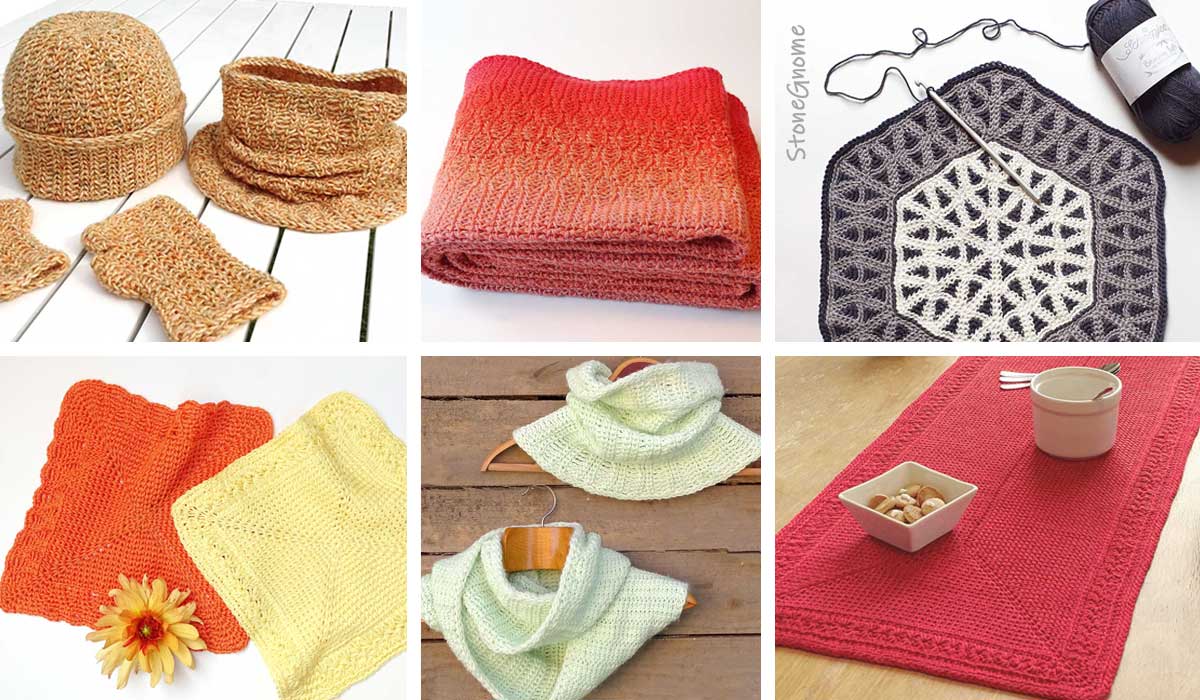
You can make a pillow from the mandala pattern or crochet something for your father to wear that can keep him warm during winter. Gloves, ear warmer, a beanie, or a cowl. 


The musician Brian Margell recently crocheted an infinity scarf for his wife. See his photos on Instagram @margellmusic 


The Patterns

All waistcoat stitch patterns can be found from the menu Themes > Waistcoat Stitch LOVE.

Paid patterns can be purchased from Ravelry or at the StoneGnome shop.

Use the code DAD2023 to get the discount.
(At Ravelry or at the Stonegnome shop only).

The code expires on June 14th (UTC).


crochet patterns using the waistcoat stitch
Share
Pin
No comments
The waistcoat stitch is a lovely little thing and you can make beautiful yet easy and fast-worked stitch patterns with it. Let me show you.

Waistcoat stitch and stitch pattern tutorial

Share
Pin
No comments
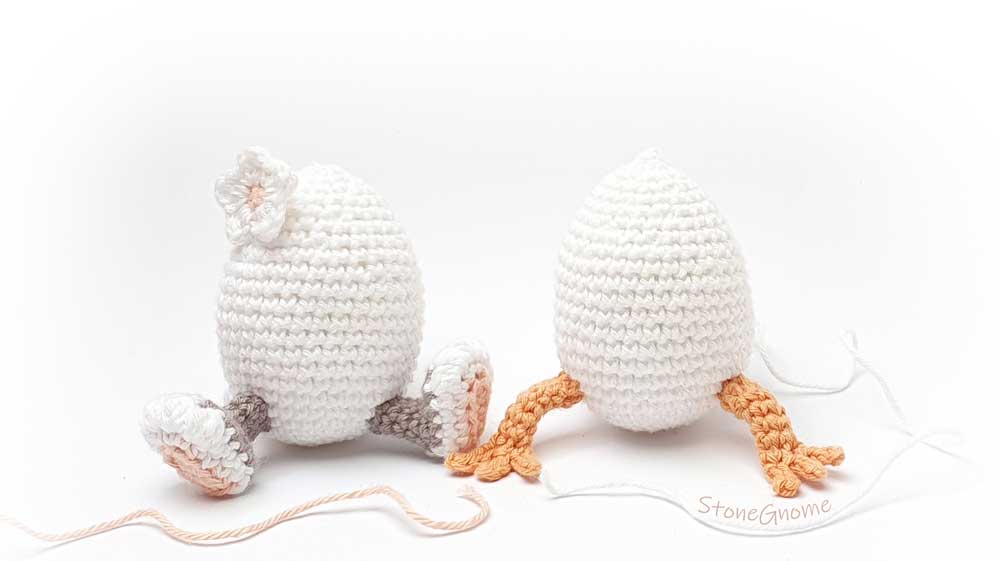
Bunny Egg usually hangs out around Easter enjoying the company of Junior Egg. 

Crochet Easter Bunny Egg and Junior Egg

Hence, the pattern for Bunny Egg has been updated and now includes Junior Egg. The two of them love that ♥ 

The 2-in-1 pattern is available at Ravelry, LoveCrafts or you can purchase it in the StoneGnome Payhip store. It's available in English and Danish.

If you want to try Junior Egg for FREE, then you'll find Junior right here.

Updated. This post has been updated as of March 2023

Skill level

The pattern is written for crocheters that are familiar with amigurumi. Difficulty level is intermediate/advanced. There are a few special stitches like BLO and Puff stitches. They are slightly modified, but - of course - explained.

Junior is the easiest one to make, while you might need a little peace, glasses and good light when you make the legs for Bunny Egg.

Size and Yarn

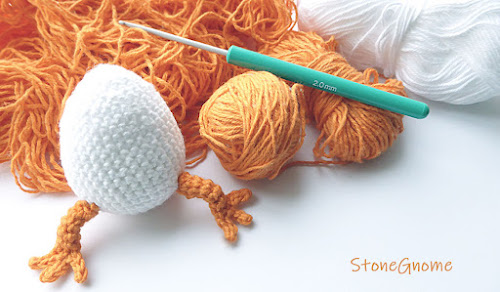
The Easter Egg will be around 6.5cm tall (2.6") if you work with the recommended hook size 2-2.5mm (US 0-B1 or steel 4, UK 14-13).

Use regular cotton yarn for amigurumi.

It could be something like Scheepjes Cotton 8 or similar.
Colors could be:
  • 502 white
  • 710 grey
  • 649 soft coral (or 715 nude).
  • 639 Burned Orange.
Bunny Egg and Junior Egg


I tried Scheepjes Organicon (Ravelry link), which was soft and lovely to work with. Even a bit thick and fluffy in the right way. Totally recommend this for a luxury project and if the egg is for decoration purposes only.

However, if you plan to use the Easter Egg as a toy, the yarn might get a little worn out faster than other yarn. At least that is what I experienced when I used it for samples and had to frog it several times.

More versions

Margie helped test and proofread the original patterns. Check out her latest colorful Junior Eggs from 2023 or her very, very cute Bunny Egg on Instagram. 

Thank you Margie for being such a patient and positive tester and proofreader.

Enjoy the pattern and Easter!

Related blog post: Junior Egg
Share
Pin
No comments
This heart was made for#WorldHeartDay (sep 2022), but it also works perfectly for Valentines Day.

World Heart Day - free crochet pattern

Use the heart to remind you of what is important in your life and what makes you happy. ❤ 

Written Pattern

Use any yarn and hook that works for you. I used Scheepjes Catona and hook 3.5 mm (US E/4- UK 9)

Abbreviations
(US terms)
ss    - slip stitch
ch    - chain
sc    - single crochet
hdc  - half double crochet
dc    - double crochet
[ ]    - all in the same stitch

Make a Magic Ring. Work 1st round in the Magic Ring.

Round 1 
Ch 1, 3 dc, 2 sc, 1 hdc, 1 dc, 1 hdc, 2sc, 3 dc, ch1 and 1 sc in the ring.
Pull the magic ring semi-tight.

Round 2 
sc in the chain, (2dc in the next st) x 4, 
1 hdc in the sc, 1 hdc in the hdc,
[1 hdc, 1 dc, 1 hdc] in the dc, 
1 hdc in the hdc, 1hdc in the sc, 
(2dc in the next st) x 4, 
1 sc in the chain, 1 ss in the sc.

Pull the magic ring as tight as possible (don't break the yarn). Cut the yarn and pull at the last loop on the hook till the strand is free. Pull tight and weave in ends.

Pattern Chart

If you prefer a chart, then see below. I will post these on Instagram too. 

Round 1 starts at the red dotted line. Round 2 starts at the blue dotted line.

❤ StoneGnome


If you want more hearts, then check out my other small heart posts. I love hearts ❤
Share
Pin
2 comments
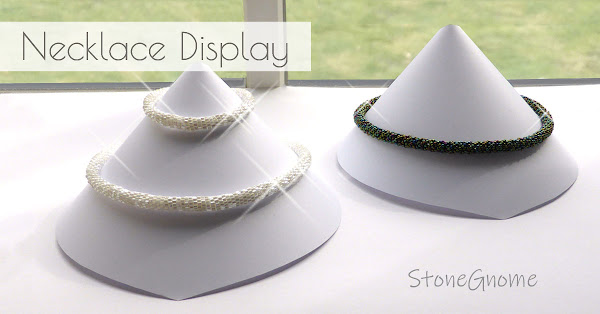
Make an angel display for a crocheted necklace or a beaded crochet necklace. The display can be used for selling items at a market, if you attend an exhibition, or maybe for a special gift. 
Necklace Display - for Beaded Crochet Necklaces
I made the display in 2017 for an exhibition I was attending with other textile and yarn freaks; weavers, filters, knitters, and crocheters. I wanted to present my crocheted necklaces in a nice way.

UPDATE: Due to requests, this writing and the templates below have been updated in January 2023.

First, I found a template (and tutorial) at Georgia P Designs. There are cones for bracelets, a cone for a necklace, and a flat-back necklace display stand.

However, one of my necklaces comes with a tight bracelet. I wanted the necklace and the bracelet to be on the same display, which required the bottom of the template to be rather wide compared to the top of the template. Otherwise, the distance between the two would be too big.

After playing around for a little while, I ended up with a display shaped like angel wings. 
The files are available from my google drive. You can get a full-size copy from the links.

  • Angel Display template - as JPG
  • Angel Display template - as PDF
Make the printed side the back of your cone. The print on the template files is rather pale, so it doesn't show through the paper.

If you can't print close to the edges, you can shrink it a bit (your printer dialog should help you with this) - OR you can ignore the missing print at the margins. It should be fairly easy to guess where to cut. Use the dotted line as a guide for the front tip.

Necklace Display - Angel Wings

Carefully fold it, so the back flaps overlap with about 1cm (0.4in), and glue the part that overlaps.

I've used heavy 190g A4 paper with a very smooth surface, so I sewed a couple of stitches on the back to make the necklaces and the bracelet stay in place. I've seen others cover the display with wallpaper or likewise and I'm guessing a rougher surface will prevent the necklaces from slipping.

The Exhibition

The keywords for the exhibition in 2017 were to show some of the many different things you can do with yarn and textiles. It used to be an annual recurring event in Gudhjem Museum (Denmark, Bornholm). The last years have been hard on exhibitions due to lockdowns and restrictions, but hopefully, there will be more yarn and textile exhibitions in the future. 

I enjoyed the beaded crochet work a lot, so I might also need the displays again one day.

Read more: Beaded Crochet Rope Necklace

Links to Display Ideas

Here are a couple of other display ideas and templates in case you need something special.
  • Georgia P. Designs templates and tutorial
  • A Plywood Jewelry Pyramid tutorial can be found at Collectivegen.com (former 'A Pair & Spare'), which also posted templates for a couple of Wooden Jewellery Holders in May 2022.
  • 3 other DIY Necklace displays are present at Tutorial De Artisana (eng: Craft Tutorial)
Share
Pin
No comments
It's time for Christmas Crocheting.
Christmas Ornament Patterns

Here are links to some free Christmas crochet patterns to you from StoneGnome.

Little ornaments are great to crochet and hang in the window or on a Christmas tree. They are also pretty fast to make, which is excellent if you have busy days or just need something easy to make.

I love the crochet snowflakes. They are small, bright, and last all winter as window decorations. And btw, there are two different versions. The second snowflake might have been hiding, so use the link below :)

I also love hearts; you can use them for more yearly occasions. And then of course the pretty stars. Very easy and relaxing to make.
  • World Heart Day
  • Snowflake #1
  • Snowflake #2
  • A Little Christmas Heart
  • Sibling Stars
  • Double Heart

Christmas Crochet Ideas

If you get into it and suddenly have a lot of crochet beauties, then use the crocheted items as part of your Christmas wrapping for a more personalized look and feel on the presents. Or make a tree branch mobile by hanging ornaments on a pretty curly branch from the garden.

Happy Christmas Crocheting!
Share
Pin
No comments
Newer Posts
Older Posts

Newsletter

Don't miss the next tip or pattern
from StoneGnome.

Find StoneGnome at

  • Ravelry
  • LoveCrafts
  • Littlebugz

  • Facebook
  • YouTube
  • Pinterest
  • Instagram

Loop Legends

  • From Image to Crochet Chart
  • Tunisian Crochet Cast On
  • Free Snowflake Pattern
  • Fluffy, Fuzzy and Fur Yarn Tips
  • Mini Neck Warmer
  • How to Find Your Gauge
  • You Don't Need a Tunisian Crochet Hook
  • Knit Bornholm 2016

My favorite Links

  • StoneGnome Pattern Shop
  • StoneGnome at Ravelry
  • StoneGnome at LoveCrafts
  • Crochet Kim
  • Annie's Catalog
  • Designing Vashti
  • Stitch Fiddle
  • Stitchboard · Pattern Wizard
  • Free Vintage Crochet

Labels

Bornholm Split Crochet advanced amigurumi basic beads christmas crochet crochetChart easter edge felting filetcrochet freePattern guide hat miteredCorner ornament paidPattern pattern ribbing shoes slipStitch spiral stitchPattern topStitch tunisian tutorial

All Crocheticles

  • ▼  2025 (3)
    • ▼  June (1)
      • Slim Tunisian Breeze Scarf
    • ►  February (1)
    • ►  January (1)
  • ►  2024 (6)
    • ►  December (1)
    • ►  November (1)
    • ►  October (2)
    • ►  April (1)
    • ►  March (1)
  • ►  2023 (7)
    • ►  September (2)
    • ►  June (2)
    • ►  March (1)
    • ►  February (1)
    • ►  January (1)
  • ►  2022 (3)
    • ►  November (1)
    • ►  April (1)
    • ►  February (1)
  • ►  2021 (9)
    • ►  November (1)
    • ►  October (3)
    • ►  September (2)
    • ►  May (1)
    • ►  March (1)
    • ►  February (1)
  • ►  2020 (15)
    • ►  December (1)
    • ►  November (1)
    • ►  October (2)
    • ►  May (2)
    • ►  March (2)
    • ►  February (3)
    • ►  January (4)
  • ►  2019 (8)
    • ►  December (2)
    • ►  October (2)
    • ►  September (1)
    • ►  May (1)
    • ►  March (1)
    • ►  February (1)
  • ►  2018 (15)
    • ►  June (3)
    • ►  May (1)
    • ►  April (4)
    • ►  March (1)
    • ►  February (4)
    • ►  January (2)
  • ►  2017 (48)
    • ►  December (4)
    • ►  November (3)
    • ►  October (2)
    • ►  September (5)
    • ►  August (5)
    • ►  July (3)
    • ►  June (5)
    • ►  May (3)
    • ►  April (4)
    • ►  March (5)
    • ►  February (5)
    • ►  January (4)
  • ►  2016 (25)
    • ►  December (5)
    • ►  November (7)
    • ►  October (5)
    • ►  September (4)
    • ►  August (4)
FOLLOW STONEGNOME @INSTAGRAM

    Ⓒ StoneGnome · Created with · by BeautyTemplates