StoneGnome

Crochet Love · Crochet & Tunisian Crochet · Studying, Developing, and Teaching Crochet Techniques

  • Home/Blog
  • Crochet
    • Basic Skills
    • Beyond the Basics
    • Advanced Crochet
    • Stitches and Stitch Patterns
  • Tunisian Crochet
    • Basic Tunisian Skills
    • Beyond the Basics
    • Advanced Tunisian Skills
    • Stitches and Stitch Patterns
  • Tutorials n Guides
    • Guides
    • Step by Step Tutorials
    • Stitches and Stitch Patterns
  • Patterns
    • Pattern Posts
    • StoneGnome Shop ♥
    • Visit Ravelry
    • Visit LoveCrafts
  • Themes
    • Slip Stitches (ss)
    • Felting
    • Hats
    • Ribbing
    • Waistcoat stitch Love
    • Top Stitch
    • Amigurumi
    • Small Hearts
    • Ornaments
    • Seasonal Themes n more
  • About
    • Contact Me
    • Copyright and Selling
    • Personal Data & Privacy
Waistcoat stitches in the round are fantastic for colorwork. They stack neatly, create a smooth, uniform fabric, and fill up space beautifully.

Crochet holder graph

If you’d like to try it, I’ve put together a small chart along with a few helpful tips.

Waistcoat stitches worked in the round are great for projects like pillows, bags, cowls, beanies, and more.

For my sample, I added 8 stitches to a round, and then the colorwork happened to fit an old glass. So, now the glass can be upgraded into a fancy crochet hook holder. - And yes, the glass is very happy with its new look.

The Heart Chart

I created the heart chart using StitchFiddle. I've shared it, so you can view or copy the chart for easy editing. FYI. StitchFiddle offers a handy progress tracker to help you keep your lines straight. 

If you prefer a paper version, click and print this image.

Hearts Crochet Chart

Never tried a Crochet Chart before?

If you're new to reading crochet charts, don't despair, it is easy to learn the basics: Each rectangle in the chart represents one stitch. Since this pattern is worked in the round, keep working in the same direction and do not turn your work. Read every round from right to left (if you are left-handed from left to right) and keep following the chart in the same direction as you crochet.

waistcoat stitch color graph

Just to let you know how easy it is, here is a written version of the beginning - BUT, please read additional notes further below before you do anything but a swatch:

Foundation. Chain 33 or more (I made 41).
  1. Work 1 single crochet stitch into each chain. (I prefer turning the chain over to insert my hook into the back bumps.). This is line 1 on the chart.

  2. Do not turn - instead, join into a ring by making a waistcoat stitch in the first stitch of your first line. Continue working in the round. As you follow the chart, work each stitch in the color shown for that rectangle.

  3. Continue working in the round and remember to change color right before every colored rectangle - see color change tip at the bottom of the page.
Repeat line 3.
❤️ · ❤️ · ❤️

Tips n Tricks

To get the best out of the waistcoat stitch colorwork, these additional notes can be helpful.

Keep the Waistcoat Stitches Straight

Waistcoat stitches don’t have to lean a lot! For a cleaner look make waistcoat stitches the right way. Insert your hook right before the vertical bar at the back of the stitch. (If you’re right-handed, this means inserting the hook on the right side of the bar.) This utilizes softer stitches and fabric and the stitches will lean a lot less.
Read more: Waistcoat stitch patterns in the round

Tension & Sizing

In case size is important to you.

  • The chart is designed for a gauge of 20 stitches × 28 rows per 10×10 cm (4″×4″).
  • I used a 4mm hook (US: G6) and Scheepjes Organicon, a very soft cotton yarn.
  • The final size of my work will be around 10cm (4") wide and 8 cm (3.1") tall. - Remember I added 8 sts to the chart for a full round.

I crocheted quite tight, so you can likely achieve the same gauge with maybe a 3mm hook (US:~D3) and a looser tension.

The hearts should still look great even if your gauge isn’t exact, but if size matters, be sure to make a swatch first.

Tapestry or Not?

Decide whether you want to:
  • Carry and crochet over the unused yarn throughout as for tapestry crochet
  • or let the unused strands float on the back. If you want to keep them under control, either twist the strands or just crochet over the unused yarn at every 4-6 stitch
Note. In tapestry crochet using waistcoat stitches, it is easy to accidentally catch the carried yarn when pulling up a loop. Also, be aware that tapestry crochet makes the fabric slightly taller, as each row takes up more space.

Color Changes

Make smooth color transitions by changing color at the last yarn-over of the previous stitch - except when creating a single, isolated 'V' in the design. In that case, simply pull up the alternate color once, then continue with the main color.


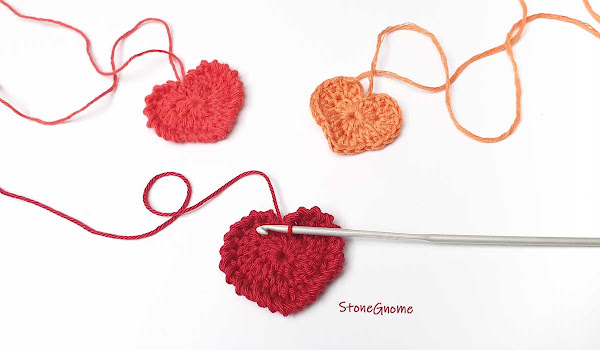
One stitch crochet heart

Happy crocheting! ❤️

Share
Pin
No comments
The twisted single crochet stitch adds charm to your project without too much fuss. Perfect for a simple border to frame your crochet work.

Make a twisted single crochet stitch for a border

Also, we’ve all had an edgy border, that could use a little LTC. The Twisted Single Crochet Stitch will help you do that. It is simple and easy to do. 

The twisted single crochet stitch is an excellent alternative to the crab stitch or the reverse single crochet stitch.

Note for British Crocheters - The term single crochet (SC) in US patterns corresponds to the double crochet (DC) in British terminology.

The Twisted Single Crochet Stitch - Instructions

  1. Insert your hook into the next stitch and pull up a loop.

  2. Pro tip: Expand the stitch a little - about twice as tall as usual. This makes the twist stand out and keeps the border softer and easier to work with.

    Pull up a tall loop


  3. Next, gently turn your hook towards yourself and all the way around. Counter-clockwise if you are right-handed (clockwise if you’re left-handed). This twists the loops on the hook. 

    Turn or twist the hook around

    Twist the single crochet stitch


  4. Finish the stitch with a yarn-over and pull through all loops.

    Finish the crochet stitch as usual


That’s it. The twisted single crochet stitch is simple, yet so effective! If you’d rather follow along with a video, you can check it out here.


Hearts to Love

Looking for a heart pattern to pair with the twisted single crochet stitch? Try the World Heart Day crochet pattern!.

World Day Heart Crochet Pattern

For more heartwarming designs, explore the other heart patterns here at stonegnome.com. 

Share
Pin
No comments

It is fall, Socktober, and the perfect time to make something warm and cozy.

Comfy Crochet Footies

These footies are soft, cushy, and easy to make. The stitch pattern is anti-knotted and stretchy. This offers a great fit, adapting comfortably to various foot shapes—something rarely achieved with crochet.

Plus, it's a toe-up pattern, and the foot and heel are crafted in one piece, minimizing seams and ensuring maximum comfort without irritation.

Crochet sock toe-up

Get the Pattern Now

The Comfy Footies pattern is available in English (US terms) and Danish.

Get it from your preferred pattern pusher; Ravelry, LoveCrafts, or right here via the StoneGnome Shop.

Size

The pattern supports shoe sizes EU 35-40 (US women 5-9, UK 3-7).

It was originally made for a female foot size EU 37/38 (US 6-7, UK 4-5). However, thanks to the flexible stitch pattern, the footies were easily adapted a couple of sizes up/down.

Yarn

What yarn to use? Bulky, fine, or super fine wool yarn (and blends) work great for this pattern. If you have a lighter yarn, simply hold 2-3 strands together to achieve a heavier weight. See more in the pattern.

Read more: Crochet with 3 strands

I made great tests with yarn like those below, though any yarn that works for you is allowed :) :

  • Ren Naturuld (bulky)
  • Asta and Lane Cervinia (2 strands)
  • Mayflower Andes (3 strands)
I'm short on images for all the footies, but I'll try to add some to Instagram soon.

Comfy Crochet Footies

Crochet footies size 35-40


Share
Pin
No comments
The waistcoat stitch is a brilliant two-faced thing. But be aware of the waistcoat stitch trap!

The knit stitch aka waistcoat stitch

To unlock the waistcoat stitch's full potential, it helps to know its secrets and understand the nuances of the waistcoat stitch.

Most crocheters call the waistcoat stitch dense and sturdy while a few of us love it for its drapiness and flexibility.

And why is that? Because there are at least TWO versions of the waistcoat stitch! They differ slightly in appearance and significantly more in structure and flexibility.

You should know about both versions, so you can choose which one to use for a project.

How to Work the Waistcoat Stitch(es)

The Basics

The stitch is created by inserting the hook between the legs of the next stitch.

And then there is a trap: There is a vertical bar at the back of the stitch*. It matters whether the hook is inserted before or after this vertical bar. Zoom in at the topmost image to see it.

*Note. Actually, there are two bars at the back. The main culprit is a very straight up-and-down (vertical) bar, while the other is slanted and sits on the side of the stitch. The slanted strand is positioned so far to the side that I doubt anyone considers using it today when working a 'normal' waistcoat stitch. If we count it, we have 3 versions of the stitch. I will disregard this 3rd version for now.

The Most Common Waistcoat Stitch version

Most crocheters naturally insert the hook AFTER the vertical bar at the back. For right-handed crocheters, this is at the left side of the back bar. This is the natural motion when you have the hook in one hand and push it into a stitch.

The waistcoat stitch, natural move of the hook

This gives you one version of the stitch. The denser one.

Currently, the tight version of this stitch is commonly demonstrated in tutorials for the waistcoat stitch. It is likely that most crocheters are not aware of the alternative option or do not consider it to be important.

The 'Secret' Waistcoat Stitch version

Another option is to insert the hook BEFORE the bar at the back. For right-handed crocheters, this means inserting the hook at the right side of the back bar.

This gives you another version of the stitch. A stitch with more drape.

Stitch Hacks

There are different approaches of how to insert the hook when working the last stitch version.

Method #1
Some crocheters elegantly twist their hook, angling it more directly into the stitch or even slightly backward, in the opposite direction. Some of my testers prefer this.
Olga Poltava recently uploaded a YouTube video demonstrating this way of entering a stitch.

Method #2
I prefer to use the lip/nose of my hook to guide the hook into the right place. If necessary, I can use my fingertip at the back of my work to keep the back bar clear of the hook

If you want to try the nose/lip first, then take a look here:


Tips for the Drapey version
  • Find a hook that works for you AND the stitch. Avoid a bulb-headed hook. It's challenging to insert a very blunt crochet hook into the center of a stitch.

    I prefer a tapered hook. However, I did have testers that worked fine with Susan Bate's inline hooks.

  • Crochet lose and control your tension. Once you have pulled up a loop lift your hook a little above the work to crochet looser. 
Read more: How to Change and Control Your Tension

And be patient. If you've never tried this version before, it's like learning a new stitch, so, it may take some time to become accustomed to.

What is the difference?

There are differences between the two versions.

Leaning and Dense

The dense version of the stitch captures more yarn, resulting in a structure where the strands are more entangled and closely packed together within each stitch. This tight interlocking of strands reduces flexibility.

As the denser stitch version grabs the back bar, it is pulled slightly to the side, causing the waistcoat stitches to lean. 

The leaning and dense waistcoat stitch

On the wrong side of the work, the stitches create a neatly structured yet slightly skewed pattern, with the stitches shifting. Being an organized chaos or a coordinated mess.

Straight and with Drape

The less dense version of the waistcoat stitch doesn't grasp the back bar. This allows the strands within each stitch to move more freely, resulting in greater flexibility in the work. Additionally, capturing less yarn means the fabric becomes slightly lighter, creating a thinner texture. With a looser structure, the fabric also gains more drape.

The less-dense waistcoat stitch version hardly leans at all. 

The straight and softer waistcoat stitch

On the wrong side, the stitches also line up beautifully inside each other.


The origin of the Waistcoat Stitch(es)

It is often impossible to determine the exact origin of a stitch, though in this case, we have an approximate idea.

In 2013 Oombawka wrote about the waistcoat stitch and found a book from 1915 (thank you for sharing, Rhondda). The book refers to the waistcoat stitch as 'the new chain stitch', so it is possible the stitch was a recent development when the book was written. 

I recently dug into the same book and was quite surprised to find BOTH versions of the waistcoat stitches in there. 

Understanding the instructions might be a bit difficult. I have highlighted the important parts showing the differences in the working methods of the two stitches. The pictures also provide a clue to distinguish between them.

The waistcoat stitch aka the new chain stitch

It looks to me like the New Chain Stitch is the drapey version of the waistcoat stitch. It looks like the stitches should line up on both sides of the work.

The German waistcoat stitch

The second waistcoat stitch version in the book is a slanted version. At the time it was called the German Waistcoat stitch.

Just to be fair. It is unclear whether the hook is inserted to the left of just one back bar or possibly to the left of both back bars, including the slanted one.
Source: The Sunlight book of knitting and crocheting p. 25-26.

Which Waistcoat Stitch Version to use?

If a pattern does not specify a certain stitch version, it's likely that the designer is only familiar with the 'German' waistcoat stitch version and designed the pattern accordingly.

Then you can choose what to use:
  • Opting for a small hook and the dense 'German' version of the stitch results in a tight, dense, and thick fabric. Cotton yarn emphasizes this. Great for sturdy things like a hat or maybe amigurumi. You also get a nice spiral look, that can be very decorative.
  • Choosing a large hook and using soft, flexible yarn to work the drapey version of the stitch results in a fabric that looks and works more like stitch-stretchy knitted stockinette. Smooth and soft. This fabric is ideal for wearables, blankets, and even softer types of amigurumi, although using a smaller hook may be preferable to keep the filling in place.
I suggest you choose what works better for a specific project and for the result you want to achieve.

Enjoy your next waistcoat stitch project :)

Share
Pin
No comments
Older Posts

Newsletter

Don't miss the next tip or pattern
from StoneGnome.

Find StoneGnome at

  • Ravelry
  • LoveCrafts
  • Littlebugz

  • Facebook
  • YouTube
  • Pinterest
  • Instagram

Loop Legends

  • From Image to Crochet Chart
  • Tunisian Crochet Cast On
  • Free Snowflake Pattern
  • Fluffy, Fuzzy and Fur Yarn Tips
  • Mini Neck Warmer
  • How to Find Your Gauge
  • You Don't Need a Tunisian Crochet Hook
  • Knit Bornholm 2016

My favorite Links

  • StoneGnome Pattern Shop
  • StoneGnome at Ravelry
  • StoneGnome at LoveCrafts
  • Crochet Kim
  • Annie's Catalog
  • Designing Vashti
  • Stitch Fiddle
  • Stitchboard · Pattern Wizard
  • Free Vintage Crochet

Labels

Bornholm Split Crochet advanced amigurumi basic beads christmas crochet crochetChart easter edge felting filetcrochet freePattern guide hat miteredCorner ornament paidPattern pattern ribbing shoes slipStitch spiral stitchPattern topStitch tunisian tutorial

All Crocheticles

  • ▼  2025 (3)
    • ▼  June (1)
      • Slim Tunisian Breeze Scarf
    • ►  February (1)
    • ►  January (1)
  • ►  2024 (6)
    • ►  December (1)
    • ►  November (1)
    • ►  October (2)
    • ►  April (1)
    • ►  March (1)
  • ►  2023 (7)
    • ►  September (2)
    • ►  June (2)
    • ►  March (1)
    • ►  February (1)
    • ►  January (1)
  • ►  2022 (3)
    • ►  November (1)
    • ►  April (1)
    • ►  February (1)
  • ►  2021 (9)
    • ►  November (1)
    • ►  October (3)
    • ►  September (2)
    • ►  May (1)
    • ►  March (1)
    • ►  February (1)
  • ►  2020 (15)
    • ►  December (1)
    • ►  November (1)
    • ►  October (2)
    • ►  May (2)
    • ►  March (2)
    • ►  February (3)
    • ►  January (4)
  • ►  2019 (8)
    • ►  December (2)
    • ►  October (2)
    • ►  September (1)
    • ►  May (1)
    • ►  March (1)
    • ►  February (1)
  • ►  2018 (15)
    • ►  June (3)
    • ►  May (1)
    • ►  April (4)
    • ►  March (1)
    • ►  February (4)
    • ►  January (2)
  • ►  2017 (48)
    • ►  December (4)
    • ►  November (3)
    • ►  October (2)
    • ►  September (5)
    • ►  August (5)
    • ►  July (3)
    • ►  June (5)
    • ►  May (3)
    • ►  April (4)
    • ►  March (5)
    • ►  February (5)
    • ►  January (4)
  • ►  2016 (25)
    • ►  December (5)
    • ►  November (7)
    • ►  October (5)
    • ►  September (4)
    • ►  August (4)
FOLLOW STONEGNOME @INSTAGRAM

    Ⓒ StoneGnome · Created with · by BeautyTemplates