StoneGnome

Crochet Love · Crochet & Tunisian Crochet · Studying, Developing, and Teaching Crochet Techniques

  • Home/Blog
  • Crochet
    • Basic Skills
    • Beyond the Basics
    • Advanced Crochet
    • Stitches and Stitch Patterns
  • Tunisian Crochet
    • Basic Tunisian Skills
    • Beyond the Basics
    • Advanced Tunisian Skills
    • Stitches and Stitch Patterns
  • Tutorials n Guides
    • Guides
    • Step by Step Tutorials
    • Stitches and Stitch Patterns
  • Patterns
    • Pattern Posts
    • StoneGnome Shop ♥
    • Visit Ravelry
    • Visit LoveCrafts
  • Themes
    • Slip Stitches (ss)
    • Felting
    • Hats
    • Ribbing
    • Waistcoat stitch Love
    • Top Stitch
    • Amigurumi
    • Small Hearts
    • Ornaments
    • Seasonal Themes n more
  • About
    • Contact Me
    • Copyright and Selling
    • Personal Data & Privacy

A slim and light scarf is always useful — whether in spring or fall, on chilly summer nights, or indoors during the cold winter months.

Slim Tunisian Breeze Scarf

This scarf is also the PREMIERE of the unique Tunisian Breeze Stitch — a stitch I absolutely love for its softness, texture, and drape! 

It’s flexible lengthwise and, despite its long, ribbed texture, feels wonderfully light and delicate — the perfect way to show off this beautiful new stitch.

The Slim Tunisian Breeze Scarf pattern

This slim scarf pattern has actually been available for a while now, but between family and work, I couldn't find time to share it properly. Now, I finally have a quiet moment to write about it here.

The Slim Tunisian Breeze Scarf Pattern includes:

  • Yarn and stitch guides
  • Helpful photos and clear written instructions (3 pages)
  • A cheat sheet and a chart for easy reference

Slim Tunisian Breeze Scarf

Find the pattern on your preferred platform:
  • Ravelry
  • LoveCrafts
  • StoneGnome Shop
Or click the button to buy it now
Buy Now

The Tunisian Breeze Stitch

The Tunisian Breeze Stitch is a Tunisian crochet stitch pattern, I designed and named. I wanted something new - easy to work, and with open stitches and as few 'knots' as possible.

The stitch is very easy to work with, curl-free, and reversible. Once you get the stitch and find a rhythm, it works up quickly — pure crochet relaxation.


Ribbed effect on Tunisian crochet scarf

But you don’t have to take just my word for it. Testers of the Slim Tunisian Breeze Scarf had lovely things to say about the stitch too. Here's a glimpse of their feedback:
"Easy and fun to work up."
"Great stretchiness."
"Very stretchy!"
"Once you get the flow, it’s very easy and goes really fast."
"An intriguing way to work Tunisian crochet."
"No curl!"

Yarn Matters

It’s important to know that cotton - and similar stiff yarns - will not work well with this stitch, as cotton has no stretch.

The stitch pattern requires a soft, drapey yarn with some stretch-and-rebound when you pull it. The best choice is a yarn based on animal fibers like wool yarn and Alpaca blends. They really make the stitch pattern pop, adding depth and softness.

Acrylic can be used — just be aware that the texture will be less defined. However, a soft, stretchy acrylic will still make it lovely in its own way.

Slim Tunisian crochet scarf


Yarn Thickness

As this is a slim, lightweight scarf, it’s designed for relatively thin yarn.

Choose something with at least 210m/50g (or 230 yds per 1.76 oz) — or even finer. This falls into the fingering or sport weight range (US) or 4-ply/Sport in UK terminology, but toward the lighter end.

Hook

You do not need a special Tunisian hook for this — a normal, straight crochet hook without a handle is perfect. You can wrap a rubber band around the far end to improve grip and prevent loops from falling off.

Make your ow handle on the crochet hook

Read more: How to Hold Your Hook and Avoid Pain from Crochet
Read more: You Don't Need a Tunisian Crochet Hook

Hook & Swatch

Grab a 4–5mm hook and make a few small swatches (instructions are in the pattern). Then select the hook size that works best for your yarn.

Yarn Usage and Blocking & Stretching

With a yarn as described above and a 4-5mm hook, you’ll need less than 400m (440 yds) of yarn.

The stitch is extremely stretchy — a scarf measuring 140 cm (55 in) can easily stretch to 2 m (79 in) after washing and blocking. And yes, you should wash and block it! It really brings out the ribbing and adds impressive length to the finished scarf.

EXCEPT if you use 100% acrylic. Acrylic does not stretch much with blocking. In this case, plan to use about 30% more yarn and crochet to the full final length you want.

A little Encouragement

Treat yourself to the yarn the scarf deserves and give the Tunisian Breeze stitch a try. Enjoy making a truly one-of-a-kind scarf - soft, stretchy, and a joy to wear.

Slim Tunisian Breeze Scarf

Find the pattern on your preferred platform:
  • Ravelry
  • LoveCrafts
  • StoneGnome Shop
Or click the button to buy it now
Buy Now

Share
Pin
No comments
Waistcoat stitches in the round are fantastic for colorwork. They stack neatly, create a smooth, uniform fabric, and fill up space beautifully.

Crochet holder graph

If you’d like to try it, I’ve put together a small chart along with a few helpful tips.

Waistcoat stitches worked in the round are great for projects like pillows, bags, cowls, beanies, and more.

For my sample, I added 8 stitches to a round, and then the colorwork happened to fit an old glass. So, now the glass can be upgraded into a fancy crochet hook holder. - And yes, the glass is very happy with its new look.

The Heart Chart

I created the heart chart using StitchFiddle. I've shared it, so you can view or copy the chart for easy editing. FYI. StitchFiddle offers a handy progress tracker to help you keep your lines straight. 

If you prefer a paper version, click and print this image.

Hearts Crochet Chart

Never tried a Crochet Chart before?

If you're new to reading crochet charts, don't despair, it is easy to learn the basics: Each rectangle in the chart represents one stitch. Since this pattern is worked in the round, keep working in the same direction and do not turn your work. Read every round from right to left (if you are left-handed from left to right) and keep following the chart in the same direction as you crochet.

waistcoat stitch color graph

Just to let you know how easy it is, here is a written version of the beginning - BUT, please read additional notes further below before you do anything but a swatch:

Foundation. Chain 33 or more (I made 41).
  1. Work 1 single crochet stitch into each chain. (I prefer turning the chain over to insert my hook into the back bumps.). This is line 1 on the chart.

  2. Do not turn - instead, join into a ring by making a waistcoat stitch in the first stitch of your first line. Continue working in the round. As you follow the chart, work each stitch in the color shown for that rectangle.

  3. Continue working in the round and remember to change color right before every colored rectangle - see color change tip at the bottom of the page.
Repeat line 3.
❤️ · ❤️ · ❤️

Tips n Tricks

To get the best out of the waistcoat stitch colorwork, these additional notes can be helpful.

Keep the Waistcoat Stitches Straight

Waistcoat stitches don’t have to lean a lot! For a cleaner look make waistcoat stitches the right way. Insert your hook right before the vertical bar at the back of the stitch. (If you’re right-handed, this means inserting the hook on the right side of the bar.) This utilizes softer stitches and fabric and the stitches will lean a lot less.
Read more: Waistcoat stitch patterns in the round

Tension & Sizing

In case size is important to you.

  • The chart is designed for a gauge of 20 stitches × 28 rows per 10×10 cm (4″×4″).
  • I used a 4mm hook (US: G6) and Scheepjes Organicon, a very soft cotton yarn.
  • The final size of my work will be around 10cm (4") wide and 8 cm (3.1") tall. - Remember I added 8 sts to the chart for a full round.

I crocheted quite tight, so you can likely achieve the same gauge with maybe a 3mm hook (US:~D3) and a looser tension.

The hearts should still look great even if your gauge isn’t exact, but if size matters, be sure to make a swatch first.

Tapestry or Not?

Decide whether you want to:
  • Carry and crochet over the unused yarn throughout as for tapestry crochet
  • or let the unused strands float on the back. If you want to keep them under control, either twist the strands or just crochet over the unused yarn at every 4-6 stitch
Note. In tapestry crochet using waistcoat stitches, it is easy to accidentally catch the carried yarn when pulling up a loop. Also, be aware that tapestry crochet makes the fabric slightly taller, as each row takes up more space.

Color Changes

Make smooth color transitions by changing color at the last yarn-over of the previous stitch - except when creating a single, isolated 'V' in the design. In that case, simply pull up the alternate color once, then continue with the main color.


One stitch crochet heart

Happy crocheting! ❤️

Share
Pin
No comments
The twisted single crochet stitch adds charm to your project without too much fuss. Perfect for a simple border to frame your crochet work.

Make a twisted single crochet stitch for a border

Also, we’ve all had an edgy border, that could use a little LTC. The Twisted Single Crochet Stitch will help you do that. It is simple and easy to do. 

The twisted single crochet stitch is an excellent alternative to the crab stitch or the reverse single crochet stitch.

Note for British Crocheters - The term single crochet (SC) in US patterns corresponds to the double crochet (DC) in British terminology.

The Twisted Single Crochet Stitch - Instructions

  1. Insert your hook into the next stitch and pull up a loop.

  2. Pro tip: Expand the stitch a little - about twice as tall as usual. This makes the twist stand out and keeps the border softer and easier to work with.

    Pull up a tall loop


  3. Next, gently turn your hook towards yourself and all the way around. Counter-clockwise if you are right-handed (clockwise if you’re left-handed). This twists the loops on the hook. 

    Turn or twist the hook around

    Twist the single crochet stitch


  4. Finish the stitch with a yarn-over and pull through all loops.

    Finish the crochet stitch as usual


That’s it. The twisted single crochet stitch is simple, yet so effective! If you’d rather follow along with a video, you can check it out here.


Hearts to Love

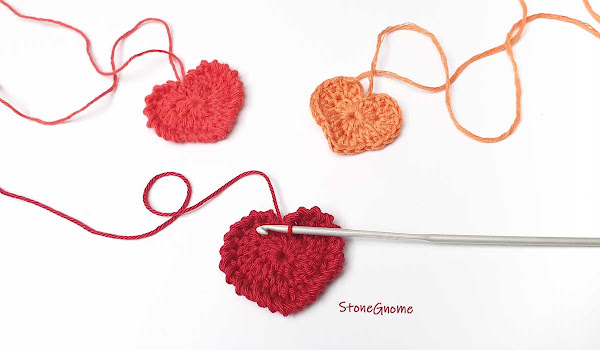
Looking for a heart pattern to pair with the twisted single crochet stitch? Try the World Heart Day crochet pattern!.

World Day Heart Crochet Pattern

For more heartwarming designs, explore the other heart patterns here at stonegnome.com. 

Share
Pin
No comments
Newer Posts
Older Posts

Newsletter

Don't miss the next tip or pattern
from StoneGnome.

Find StoneGnome at

  • Ravelry
  • LoveCrafts
  • Littlebugz

  • Facebook
  • YouTube
  • Pinterest
  • Instagram

Loop Legends

  • From Image to Crochet Chart
  • Tunisian Crochet Cast On
  • Free Snowflake Pattern
  • Fluffy, Fuzzy and Fur Yarn Tips
  • Mini Neck Warmer
  • How to Find Your Gauge
  • You Don't Need a Tunisian Crochet Hook
  • Knit Bornholm 2016

My favorite Links

  • StoneGnome Pattern Shop
  • StoneGnome at Ravelry
  • StoneGnome at LoveCrafts
  • Crochet Kim
  • Annie's Catalog
  • Designing Vashti
  • Stitch Fiddle
  • Stitchboard · Pattern Wizard
  • Free Vintage Crochet

Labels

Bornholm Split Crochet advanced amigurumi basic beads christmas crochet crochetChart easter edge felting filetcrochet freePattern guide hat miteredCorner ornament paidPattern pattern ribbing shoes slipStitch spiral stitchPattern topStitch tunisian tutorial

All Crocheticles

  • ▼  2025 (3)
    • ▼  June (1)
      • Slim Tunisian Breeze Scarf
    • ►  February (1)
      • Waistcoat Stitch Colorwork
    • ►  January (1)
      • Twisted Single Crochet Stitch for Edging
  • ►  2024 (6)
    • ►  December (1)
    • ►  November (1)
    • ►  October (2)
    • ►  April (1)
    • ►  March (1)
  • ►  2023 (7)
    • ►  September (2)
    • ►  June (2)
    • ►  March (1)
    • ►  February (1)
    • ►  January (1)
  • ►  2022 (3)
    • ►  November (1)
    • ►  April (1)
    • ►  February (1)
  • ►  2021 (9)
    • ►  November (1)
    • ►  October (3)
    • ►  September (2)
    • ►  May (1)
    • ►  March (1)
    • ►  February (1)
  • ►  2020 (15)
    • ►  December (1)
    • ►  November (1)
    • ►  October (2)
    • ►  May (2)
    • ►  March (2)
    • ►  February (3)
    • ►  January (4)
  • ►  2019 (8)
    • ►  December (2)
    • ►  October (2)
    • ►  September (1)
    • ►  May (1)
    • ►  March (1)
    • ►  February (1)
  • ►  2018 (15)
    • ►  June (3)
    • ►  May (1)
    • ►  April (4)
    • ►  March (1)
    • ►  February (4)
    • ►  January (2)
  • ►  2017 (48)
    • ►  December (4)
    • ►  November (3)
    • ►  October (2)
    • ►  September (5)
    • ►  August (5)
    • ►  July (3)
    • ►  June (5)
    • ►  May (3)
    • ►  April (4)
    • ►  March (5)
    • ►  February (5)
    • ►  January (4)
  • ►  2016 (25)
    • ►  December (5)
    • ►  November (7)
    • ►  October (5)
    • ►  September (4)
    • ►  August (4)
FOLLOW STONEGNOME @INSTAGRAM

    Ⓒ StoneGnome · Created with · by BeautyTemplates